Back to siteMACROVISION · For journalists and researchers
Press kit
MacroVision is open research on what would happen to households' purchasing power if automation and AI replaced a large share of work. Here you will find the key findings in plain language, precise wording for quotation, downloadable charts and links to the full data.
Three key findings
Simulation · Step 101
Even when benefits protect them, those who lost their jobs fall behind
"A benefit that maintains today's standard of living protects against a fall, but not against a gap that keeps widening as the economy grows."
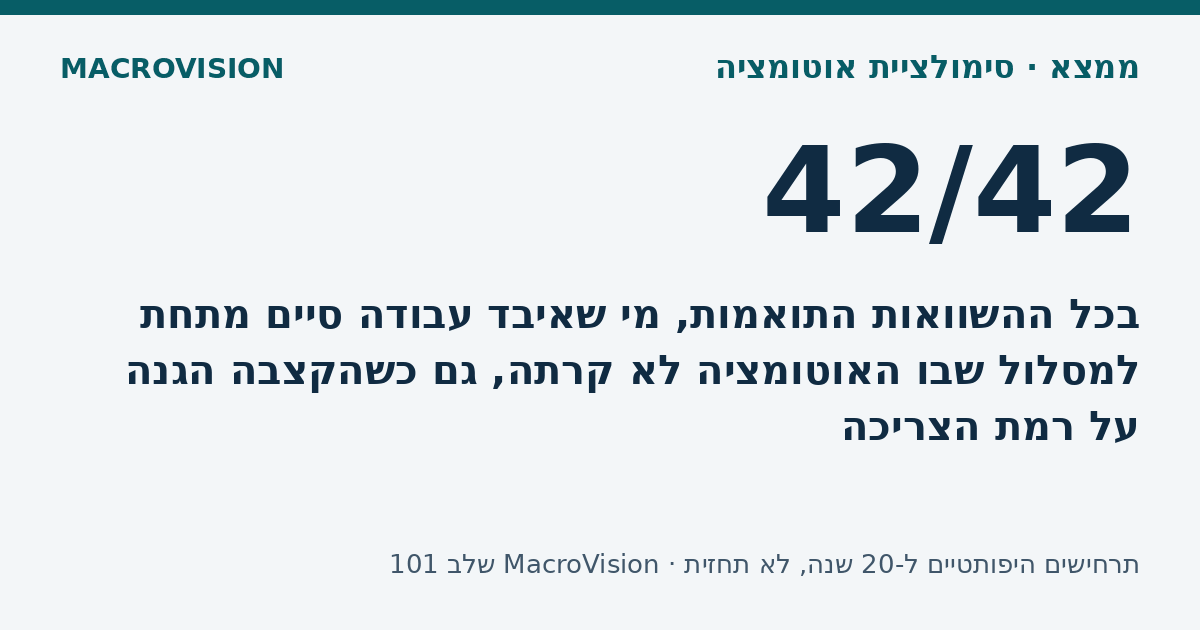
In all 42 matched comparisons, displaced workers' consumption at the end of 20 years was lower than on the path without automation.
Workers who remained employed ended above the control path in all 42 cases.
Of 202 completed paths, the consumption of both groups of displaced workers was maintained in only 75.
Falling prices did not reach renters and mortgage holders
"The benefit tracks the price of goods, but rent and mortgage payments do not fall. People who own their home outright were barely affected by pass-through."
Under full pass-through, displaced renters preserved consumption in 2 of 18 paths, versus 8 of 18 for outright owners.
The reason in the model: housing payments are fixed amounts, and the benefit is indexed only to the price of goods.
The fiscal room for benefits falls by a median 12.6% in year 10, and at the unemployment peak it runs out in 16 of 18 renter paths. So indexing the benefit to housing does not undo the harm either.
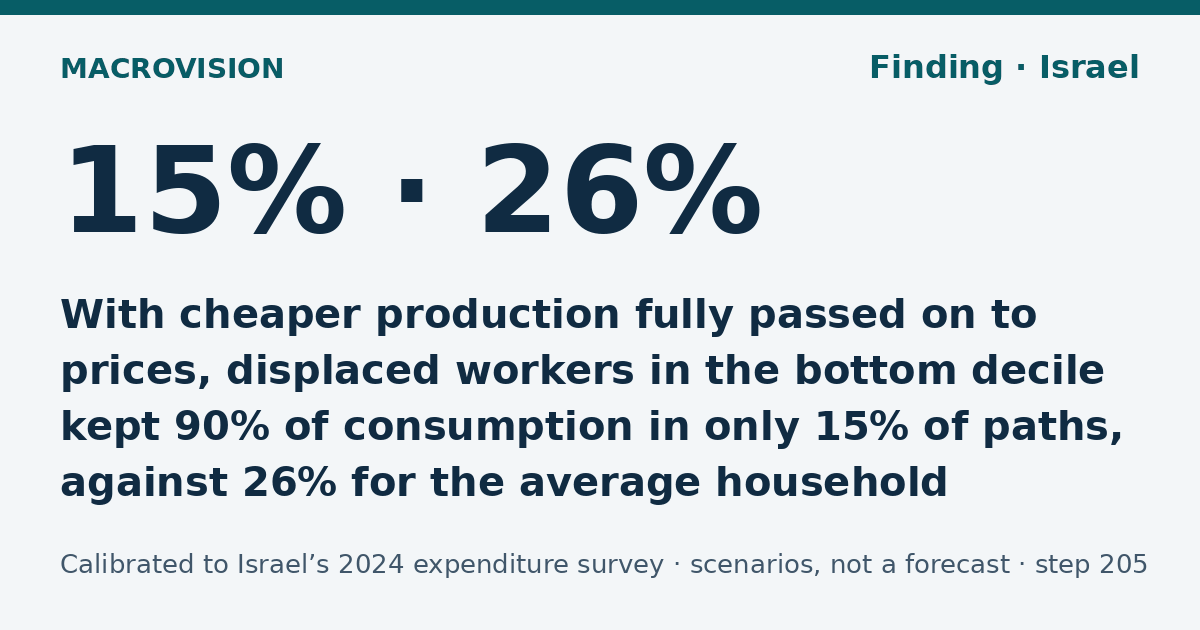
With the housing profile of Israel's bottom income decile (56.5% renters, rent about 45% of income, 2024 household expenditure survey), preservation at full pass-through falls to 15.3%. When the benefit is also indexed to housing costs it rises to 34.0%.
These are descriptive counts within a model, not an economic law.
No evidence yet that AI adoption reduces employment in exposed occupations
"In the data available today, an effect of AI on employment cannot be detected. This does not mean there is no effect, but that it is still too early to measure it."
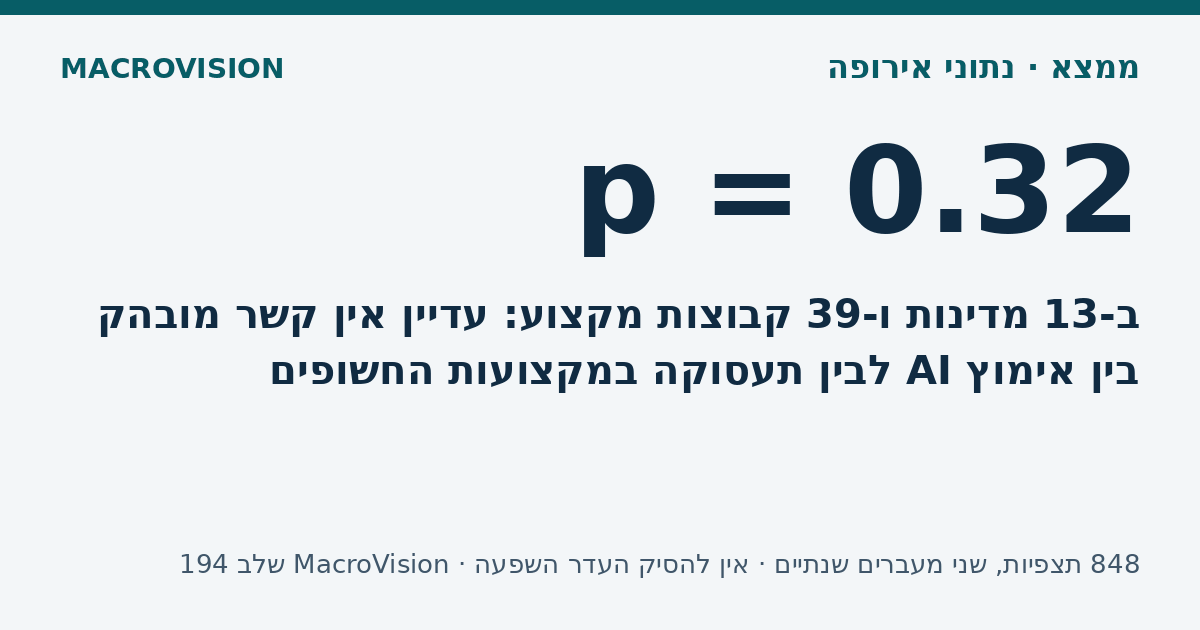
13 European countries, 39 occupational groups, 848 observations.
The estimate leans toward lower employment, but it is not statistically significant (p=0.32).
Adoption is measured at the country level rather than the occupation level, and the period covers only two annual changes.
In Israel (Labour Force Survey, 2017–2024): professionals' share of the unemployed rose from 16% to 27%, and the over-representation of clerical workers did not grow after 2023. The latest years include the war, so this is a description, not an estimate of AI's effect.