Research summary · working paper, draft 3.2, November 2026
Cheaper goods, thinner budgets
If automation pushed unemployment to 20%, could lower prices and a tax-financed benefit preserve the consumption of the workers who lost their jobs? Under what conditions?
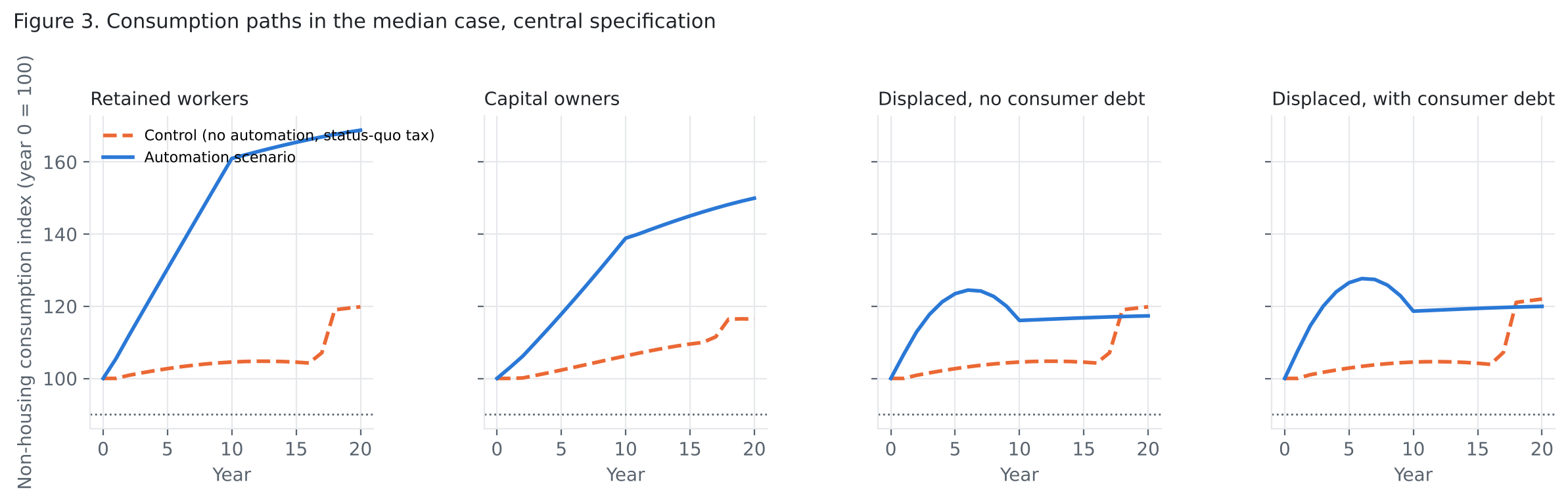
Short answer: yes in most cases, but only if automation raises output enough and the government can tax profits when public debt reaches its cap. In the central specification, a benefit that tops the displaced up to their pre-automation income, financed by a profit levy of up to 15% once the debt cap binds, keeps them at 90% or more of their consumption in 277 of 432 cases (64%), against 211 (49%) when the government can only cut the benefit. Making the levy costly shrinks this advantage and, in some specifications, trades it for more fiscal crises. And even when their consumption is preserved, the displaced fall behind those who keep their jobs unless part of the benefit is indexed to wages.
This is a stylised accounting model with a partial calibration to Israel, plus a descriptive look at the data. It describes conditions and mechanisms. It is not a forecast.